

Get Crafty with a Perfect Pom Pom Knit
What Is a Pom Pom Knit — and Why Everyone's Making One

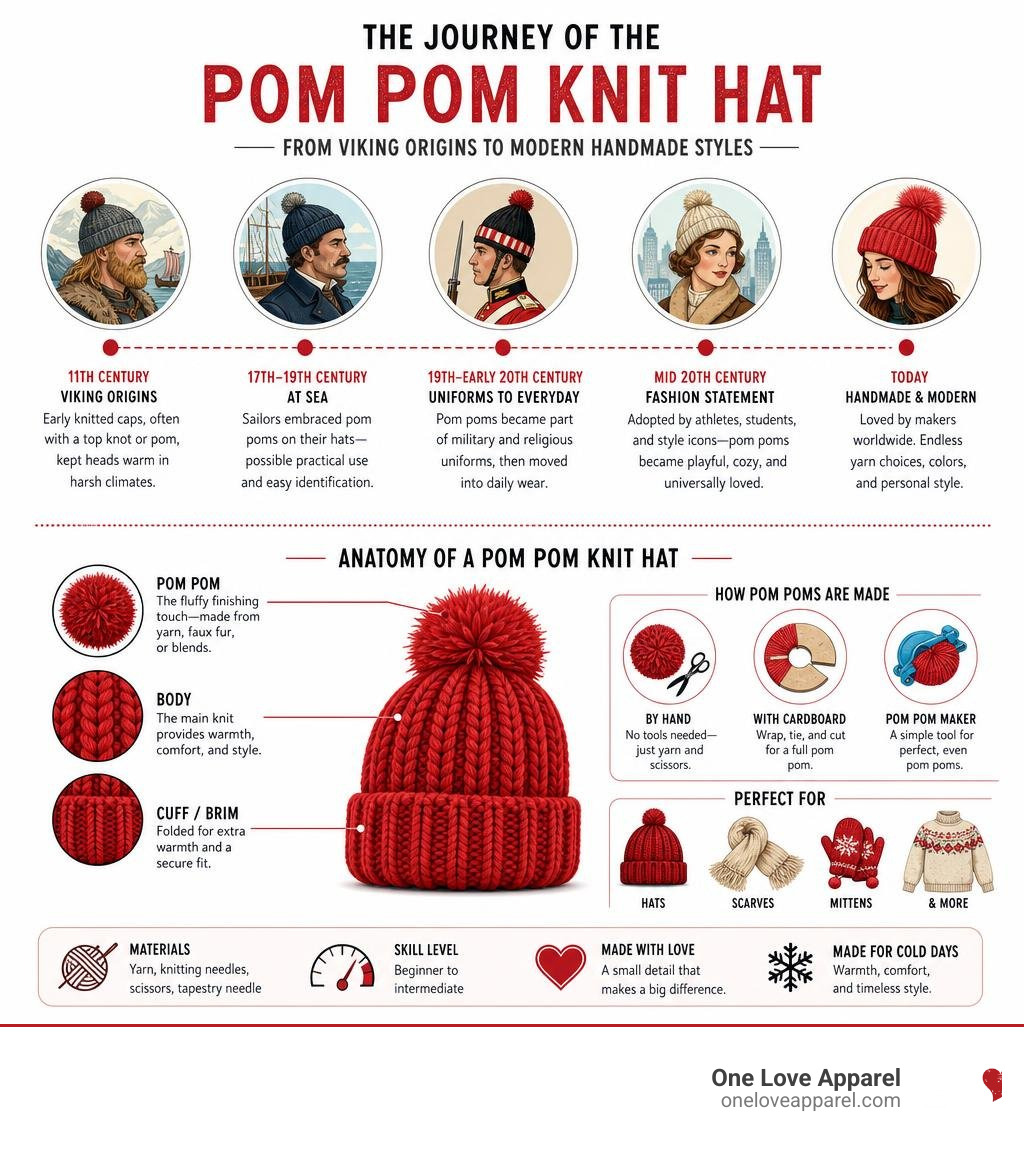
Pom pom knit accessories are handmade or machine-made knitted items — most often hats, scarves, and mittens — topped or trimmed with a fluffy yarn ball called a pom pom.
Here's a quick overview of what you need to know:
- What it is: A knitted item (usually a beanie or scarf) finished with one or more yarn pom poms
- Common projects: Hats, scarves, mittens, shawls, and even sweaters
- Key materials: Yarn (worsted, bulky, or fingering weight), knitting needles, scissors, and a tapestry needle
- Skill level: Beginner to intermediate — most pom pom hat patterns are very approachable
- Pom pom options: Made by hand (no tools needed), with cardboard, or with a commercial pom pom maker
Pom poms have a surprisingly long history. Some trace them back to Viking-era headwear as far back as the 11th century. Sailors later wore them on their hats — possibly as practical head protection. Over time, they moved from military and religious uniforms into everyday fashion, and today they're one of the most recognizable details in cold-weather knitwear.
Whether you want to knit your first beanie from scratch or just need to add that finishing fluffy touch, this guide walks you through everything step by step.
I'm David Vail, and through my work at One Love Apparel — a brand built around style, comfort, and quality — I've developed a deep appreciation for accessories like the pom pom knit that blend personality with function. I'll be your guide through every stitch and snip in this article.
Know your pom pom knit terms:
Understanding the Pom Pom Knit and Choosing Materials

When we talk about a pom pom knit, we are referring to the magical combination of cozy, textured knitwear and the playful, spherical embellishments that crown them. While hats are the most common canvas, this style extends beautifully to scarves, mittens, blankets, and even cozy sweaters. To get a professional, durable result, your journey must begin with selecting the right materials.
Selecting the proper yarn is about balancing structural integrity with softness. Because pom poms are handled, tossed into bags, and exposed to winter winds, the fiber must hold its shape without fraying into a messy cloud.
Let's break down the primary fiber choices:
- Superwash Wool: This is a favorite for daily-wear accessories. It is treated to prevent felting in the washing machine, making it highly practical. It has excellent springiness and stitch definition.
- Nylon Blends: Often combined with wool, a touch of nylon adds incredible durability and strength. This is highly recommended for lightweight, high-wear items like socks or lightweight baby beanies.
- Merino Wool: Known for its ultra-fine, next-to-skin softness, merino wool creates a luxurious fabric that feels fantastic around your forehead. It yields incredibly dense, cloud-like pom poms.
To help you plan your next project, we have put together a quick-reference guide comparing yarn weights, average gauges, and recommended needle sizes for different types of projects:
| Yarn Weight | Typical Gauge (per 4 inches / 10 cm) | Recommended Needle Size | Best Project Type |
|---|---|---|---|
| Fingering / Sock | 28 to 34 stitches | US 1 to 3 (2.25 to 3.25 mm) | Delicate baby hats, lightweight spring scarves |
| Worsted / Medium | 18 to 22 stitches | US 7 to 9 (4.5 to 5.5 mm) | Classic ribbed beanies, everyday winter scarves |
| Bulky / Chunky | 12 to 15 stitches | US 10 to 11 (6.0 to 8.0 mm) | Quick-knit cozy hats, structured textured cowls |
| Jumbo / Super Bulky | 6 to 11 stitches | US 15 to 19 (10.0 to 15.0 mm) | Statement winter sets, ultra-thick chunky beanies |
If you are looking for styling inspiration or want to compare handmade options to ready-to-wear classics, check out our guide on finding the perfect womens beanie with pom to see how different yarn weights translate to everyday winter fashion.
Step-by-Step Guide to Knitting a Basic Pom Pom Hat

Knitting your own hat is one of the most rewarding projects you can undertake. It is fast, highly customizable, and incredibly cozy. Most knitters prefer working in the round using circular needles because it eliminates the need for seaming at the end, leaving you with a smooth, comfortable tube that tapers beautifully at the crown.
If you are knitting for a little one, a great starting point is this free Baby Pom Pom Hat: Free Baby Hat Knitting Pattern, which uses a soft fingering-weight yarn to create a lightweight, comfortable fabric perfect for sensitive skin. For a standard adult hat, we will walk through the fundamentals of cast-on, ribbing, and shaping below.
Cast-On and Ribbing for Your Pom Pom Knit
The foundation of any great hat is a stretchy cast-on and a snug, elastic ribbing. If your cast-on is too tight, the hat will pinch your forehead; if it is too loose, it will slip down over your eyes.
- The Cast-On: We highly recommend using the Long-Tail Cast-On method. It provides a clean, elastic edge that stretches comfortably with the movement of your head. For a standard adult medium hat using worsted weight yarn, cast on approximately 80 to 88 stitches onto your circular needles.
- Joining in the Round: Carefully arrange your stitches on the circular needle, ensuring they are not twisted around the cable. Place a stitch marker to denote the beginning of your round, and join by knitting the first stitch of your cast-on row.
- Knitting the Ribbing: Work in a 1x1 ribbing pattern (Knit 1, Purl 1) or a 2x2 ribbing pattern (Knit 2, Purl 2). This alternating sequence of knits and purls creates a highly elastic, springy fabric that hugs the head securely. Continue this pattern until your ribbing measures about 1 to 2 inches from the cast-on edge. If you prefer a slouchy hat with a folded brim, extend this ribbing to 3 or 4 inches before transitioning to the main body of the hat.
Shaping the Crown and Decreasing
Once the body of your hat reaches your desired length (usually about 7 inches from the cast-on edge for a standard beanie, or 8.5 inches for a slouchy style), it is time to shape the crown. Decreasing the number of stitches creates a smooth, rounded top rather than a bunched, bulky mess.
To decrease while maintaining a clean look, we use the K2tog (Knit 2 Together) method or structured double decreases.
Here is a classic, simple decrease sequence for a hat with 80 stitches:
- Round 1 (Decrease Round): Knit 8, Knit 2 Together (K2tog); repeat from * to * to the end of the round (72 stitches remaining).
- Round 2 and all even rounds: Knit all stitches plain, maintaining any ribbing pattern if desired.
- Round 3 (Decrease Round): Knit 7, K2tog; repeat from * to * to the end of the round (64 stitches remaining).
- Round 5 (Decrease Round): Knit 6, K2tog; repeat from * to * to the end of the round (56 stitches remaining).
As you continue decreasing, the circumference of your stitches will become too small to stretch around your circular needle. When this happens, transition your stitches onto double-pointed needles (DPNs) or use the Magic Loop technique.
Continue this systematic decrease until you have only 8 to 10 stitches remaining. Cut your yarn, leaving a generous 12-inch tail. Thread this tail through a tapestry needle, pass it through the remaining live loops, pull it tight like a drawstring to cinch the top shut, and secure the yarn firmly on the inside of the hat.
Customizing with Stripes, Textures, and Colors
Once you have mastered the basic beanie, the creative possibilities are endless! You can customize your pom pom knit accessories with various techniques:
- Intarsia and Color Blocking: Create striking geometric patterns or divide your hat into distinct color blocks. For an advanced approach, you can even explore intarsia in the round to create a beautiful two-tone split-color hat.
- Garter Stitch and Textures: Garter stitch (knitting every row when working flat, or alternating knit and purl rounds in the round) creates a squishy, dense texture that pairs beautifully with oversized pom poms.
- Mini Pom Poms: Who says you can only have one? You can embellish the corners of a square-top hat with mini pom poms, or add them along the border of a scarf. For an artistic, multi-colored project, take a look at the ISSUEss19 Pompompop: Knitty.com - Spring + Summer 2019 pattern, which showcases how to use colorful scrap yarns to create a playful, eye-catching garter stitch shawl.
- Fun Garments: If you want to take your love for pom poms beyond accessories, check out the popular Ravelry: Pompom Pullover pattern by Amanda Kaffka, a cozy, boxy sweater designed to be adorned with playful mini pom poms across the body.
For businesses, clubs, or events looking to create a cohesive, professional look, you can design custom headwear featuring your own branding. Explore our options for creating your logo your beanie design personalized headwear to bring your unique color schemes and branding to life.
How to Make and Securely Attach a DIY Pom Pom
A beautiful hat deserves a spectacular pom pom. While commercial plastic pom pom makers are widely available, you do not need any specialized tools to achieve a dense, perfectly round, professional-looking yarn ball. In fact, many experienced makers prefer simple, tool-free methods because they allow for complete control over yarn tension and size.
If you are crafting a matching set, you can use the same yarn from your project to create a unified look. For inspiration on designing coordinated accessories, see this gorgeous Two-Tone Pom Pom Hat + Scarf: Free Knitting Pattern, which utilizes jumbo-weight yarn and a simple template to create beautiful, oversized, matching pom poms.
Crafting a Pom Pom Without a Commercial Maker
You can make a gorgeous, fluffy pom pom using items you already have around the house, such as a piece of sturdy cardboard, your own fingers, or even a cell phone!
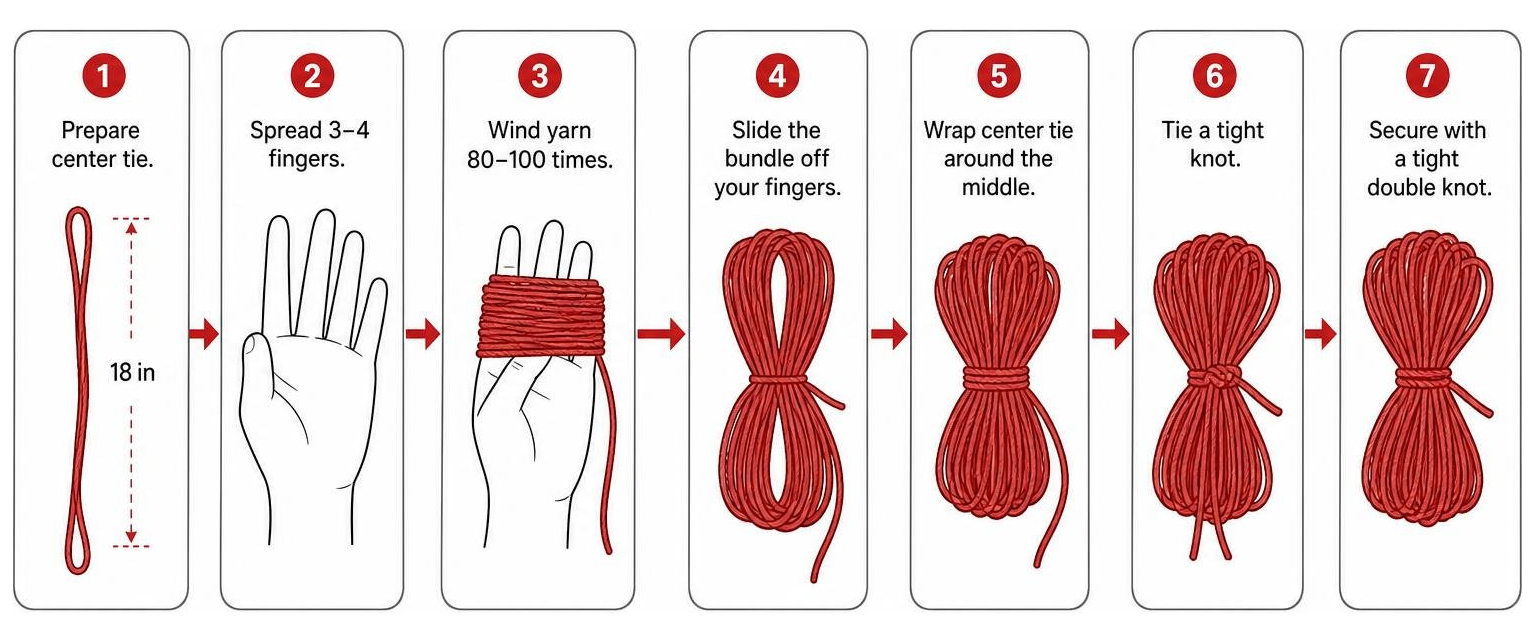
Here is how to craft one using the popular finger-winding or cardboard method:
- Prepare the Center Tie: Cut a strong, 18-inch piece of yarn (preferably a durable cotton or wool yarn) and set it aside. This will be your center tie, which must hold the entire bundle together.
- Wind the Yarn: Spread your fingers (three or four fingers depending on how large you want the pom pom to be) or use a cardboard template cut to your desired width (typically 3 to 4 inches). Begin winding your yarn around this guide. For a rich, dense pom pom, wind the yarn at least 80 to 100 times. If you are using a thinner fingering-weight yarn, you may need to wind it up to 150 times.
- Tie the Center: Carefully slide the looped bundle off your fingers or cardboard template, keeping the loops intact. Wrap your 18-inch center tie around the exact middle of the bundle. Tie a single knot, pull it as tight as humanly possible, and secure it with a tight, permanent double knot.
- Cut the Loops: Slip your scissors through the loops on both sides of the center tie and snip them open. Your bundle will suddenly spring outward into a wild, shaggy shape.
- Trim to Shape: This is where the magic happens. Hold the pom pom by the long ends of the center tie over a garbage can. Using sharp, pointy scissors, give your pom pom a meticulous "haircut," trimming away the uneven outer strands until you have a perfectly dense, uniform sphere.
Securing Your Pom Pom Knit Embellishment
A loose, floppy pom pom that sags to one side can ruin the look of an otherwise perfect hat. To prevent this, you must secure it tightly to the crown of your knitwear.
Thread the two long tails of your pom pom's center tie into a tapestry needle. Push one tail through the top of the hat's crown, just slightly to the left of the center cinch point. Push the second tail through the crown just slightly to the right of the center point.
Once both tails are on the inside of the hat, pull them firmly so the pom pom sits snugly against the knit fabric without any gaps. Tie the two tails together on the inside using a secure bow or double knot. Tying a bow instead of a permanent knot is a fantastic trick—it allows you to easily untie and remove the pom pom whenever the hat needs to go through the wash!
If you prefer the look of natural or synthetic textures, you can swap out yarn for a faux-fur alternative. Learn more about choosing and securing these options in our comprehensive buyers handbook for finding your perfect fur pom pom beanie.
Troubleshooting and Professional Finishing Tips
To elevate your hand-knitted items from "obviously homemade" to "professionally crafted," keep these best practices in mind:
- Wet Blocking: Before you attach your pom pom, wet block your finished knitting. Soak the hat in lukewarm water with a gentle wool wash, gently squeeze out the excess water in a towel, shape it, and lay it flat to dry. This relaxes the stitches, evens out your tension, and gives the fabric a beautiful drape.
- Steam Blocking: If you are using a heavy or textured yarn, a quick steam block can smooth out any minor imperfections in your ribbing.
- Preventing Loose Ties: If your center tie yarn keeps snapping when you pull it tight, switch to a strong button thread, dental floss, or a thin, durable cotton twine to tie the center of your pom pom.
- Use Sharp Scissors: Dull scissors will chew through yarn rather than slicing it clean, resulting in frayed, fuzzy ends that make your pom pom look messy. Invest in a dedicated pair of sharp sewing shears.
For those who love outdoor activities, a snug, professionally finished beanie is an absolute winter essential. If you enjoy cold-weather exercise, read our guide on running beanies for winter warmth on the run to discover which designs and materials keep you warmest when active.
If you are looking for a super-fast, ultra-cozy chunky pattern to test out your new skills, check out the Pom Bomb Hat – Wool and Company, which uses a super-bulky handspun yarn and oversized pom poms for a dramatic, winter-ready look.
Another fantastic option for classic, structured winter sets is the Pom Pom Adore / DROPS 98-6 - Free knitting patterns by DROPS Design, which features a beautiful side-to-side garter stitch hat, matching scarf, and mittens, all completed with classic yarn pom poms.
Frequently Asked Questions About Pom Pom Knits
What is the best yarn weight for a pom pom knit hat?
The best yarn weight depends entirely on your desired style and how much time you have. Worsted weight yarn is the most popular choice for beginners because it is easy to handle, offers excellent stitch definition, and works up relatively quickly on US 7 to 9 needles. If you want a quick weekend project, bulky or super-bulky yarn is incredible, allowing you to finish a hat in just a few hours. For delicate, lightweight spring beanies, a fingering-weight yarn is ideal.
How do you wash a knit item with a pom pom?
We highly recommend hand washing your knitwear in cool water with a gentle wool rinse. If your pom pom is made of yarn and permanently attached, gently squeeze the water out without wringing, and reshape the pom pom by hand while it air dries. If your hat features a faux-fur pom pom, always remove it before washing, as water can ruin the synthetic fibers.
Can you make a pom pom using household items?
Absolutely! You do not need commercial plastic makers. You can wrap yarn around a piece of sturdy cardboard cut to your desired diameter, a large metal kitchen fork (perfect for mini pom poms), or even your smart phone. Just ensure that whatever template you use is sturdy enough to withstand the tension of tight yarn wrapping.
Conclusion
Knitting your own pom pom knit accessories is a wonderful way to express your creativity, stay cozy throughout the winter, and craft heartfelt, handmade gifts for your loved ones. From choosing the perfect merino wool to mastering the art of the perfect trim, the process is as relaxing as it is rewarding.
At One Love Apparel, we believe that the best wardrobe pieces are those that combine comfort, quality, and personal expression. Just like a beautifully crafted, snug beanie keeps you warm on a chilly day, our collection of premium, lightweight t-shirts made from ultra-soft combed and ring-spun cotton provides the perfect, comfortable foundation for your everyday style.
If you are looking for more winter styling inspiration or want to explore how to coordinate your handmade beanies with activewear, check out our roundup of mens running headwear beyond the basic beanie.
We also believe that what you wear can be a powerful force for good. Discover how you can make a meaningful statement and start important dialogues by sparking conversations about causes that matter through your apparel choices. Grab your needles, pick out your favorite yarn, and start crafting your perfect winter set today!